Our approach to Sustainability
Discover how Hurtigruten is working to reduce emissions, support coastal communities and help shape the future of travel along Norway's coast.

At Hurtigruten, we’re working towards shaping a more responsible way to travel, as well as supporting Norway's efforts towards a more sustainable travel industry.
In 2025, we completed a multi-year fleet upgrade program representing an investment of approximately €150 million (appox. $171.95 million USD), including the hybrid conversion of four vessels, the installation of SCR systems on eight vessels, and measurable emissions reductions. We continue to invest in innovation and new solutions to improve energy efficiency and support the transition to a maritime industry with lower environmental impact.
Our sustainability progress as of 2026
We're continuously working to reduce our impact and improve how we sail by using technology, innovation and everyday choices on board. This is what we've achieved so far.
Cleaner fuels and propulsion
Hybrid systems are now installed on MS Nordlys, MS Richard With, and MS Kong Harald. Eight vessels are equipped with Selective Catalytic Reduction (SCR) systems, and our fleet can operate on certified biofuels (HVO/MGO blends) to help reduce emissions.
Improved energy efficiency
Upgrades across the fleet include new propeller blades, bulbous bows, gears and control systems, as well as streamlined hulls designed to optimize inertia and reduce drag while sailing.
Reduced emissions and resource use
All vessels use low-sulfur fuels and are equipped with advanced wastewater and ballast-water treatment systems. Full shore-power connectivity allows ships to plug in while in port, further reducing emissions.
Circular and responsible operations
We have removed unnecessary single-use plastics across the fleet, replacing them with biodegradable or durable alternatives. In Stamsund, a closed-loop composting program helps turn organic waste into a resource that supports local agriculture.
Key upgrades to our fleet: some facts and figures
We have completed a comprehensive fleet upgrade program focused on improving energy efficiency, supporting emissions reduction, and the conversion of four ships to hybrid-electric propulsion.
Emission reductions in 2025
18% reduction in CO₂ emissions per APCN (Scope 1) and 29% reduction in total CO₂ emissions (Scope 1+2) compared to 2018
71% reduction in NOₓ emissions compared with 2018
45% reduction in SOₓ emissions compared with 2023 (2023 was the most recent year in which we changed supplier and fuel product; compared with 2024, using the same supplier and product, the reduction was 1%)
Ongoing introduction of certified biofuels to further reduce environmental impact
More hybrid-powered ships
Four vessels now upgraded to hybrid-electric propulsion for cleaner and quieter operations
Installation of large battery packs and three of the hybrid ships have new, more energy-efficient engines
Shore power connectivity
All vessels are equipped to connect to shore power when docked, eliminating emissions in ports where shore power is available
Plastic-free and waste reduction measures
Removal of unnecessary single-use plastics across the fleet
Food waste on board is composted at a reactor in Stamsund and used as local fertilizer
Edible food waste per guest per night was 66 grams in 2025, down 6% from 2024
Energy efficiency improvements
Hull augmentations on several ships to reduce drag and improve fuel efficiency
Hull cleaning is carried up to five times per vessel during the growth season, helping to reduce biofouling, hydrodynamic resistance, fuel consumption and greenhouse gas emissions
Towards zero food waste
We are committed to minimizing food waste through our Towards Zero Food Waste initiative – a circular approach that rethinks how food is prepared, enjoyed and returned to the earth.
This program forms part of Norway's Coastal Kitchen, guided by the principles of Reduce, Reuse, and Recycle.
Reduce: Chefs prepare thoughtful portion sizes to limit surplus
Reuse: Ingredients are reimagined and transformed into new dishes
Recycle: Unavoidable food waste is converted into fertilizer


On board our Original ships, food waste is carefully collected and transported to a compost reactor in Stamsund. Within just 24 hours, natural microbial processes transform it into nutrient-rich fertilizer. This is then used at local Myklevik Farm to grow fresh produce – ingredients that eventually return to our ships, completing a continuous and regenerative cycle.
We're working to expand the composting model to more ports along the coast as part of our work on circular practices.
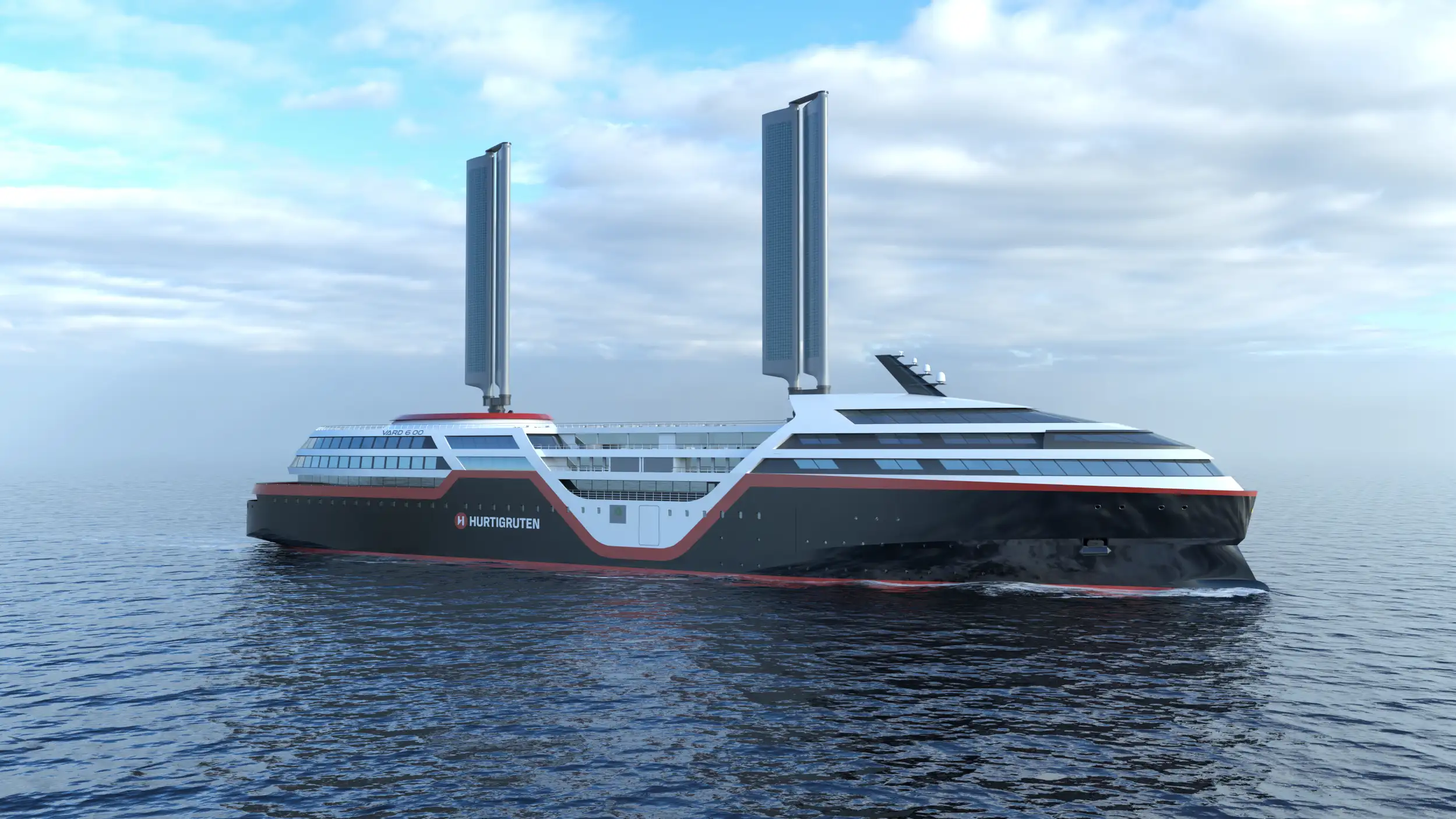
Sea Zero
Sea Zero is Hurtigruten’s research and development project for the future of coastal travel. The project has demonstrated that it is possible to build a coastal express ship that can operate without direct emissions under normal operating conditions. The main goal of the project is to reduce energy consumption by using energy-efficient technologies and mainly sail on battery power. This will require access to charging infrastructure on shore.